
Rob Fraser
March 3, 2026
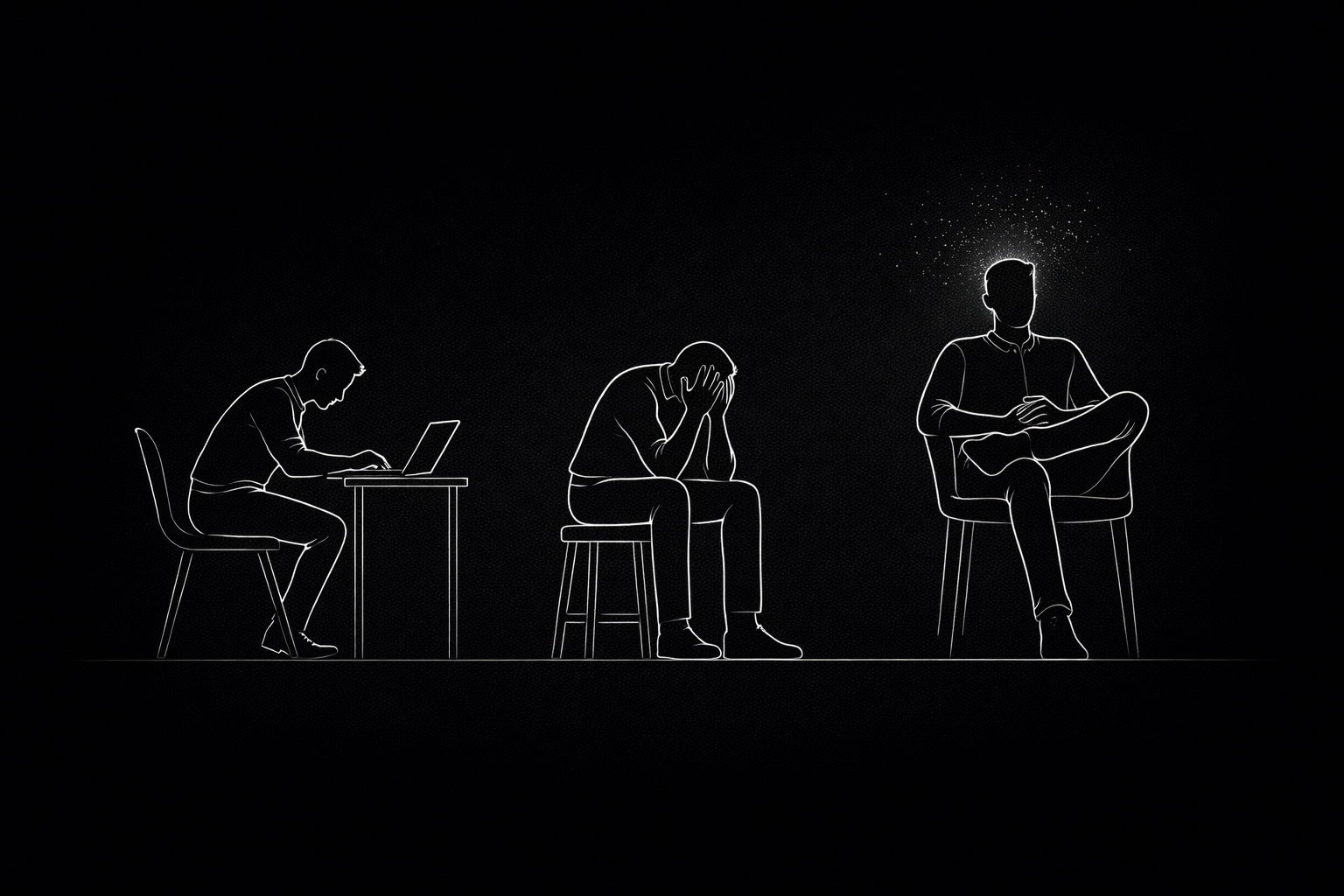
Every long-haul founder becomes three different people.
Not metaphorically. Literally. The person who starts the business, the person who nearly destroys it, and the person who finally learns how to run it. Three versions. Three operating systems. And the pain of building something over a long time horizon is almost never about the business itself.
It’s about refusing to let the previous version of yourself die.
Most founders think growth is a straight line. Start here. End there. More revenue, more people, more complexity, more success. Every year a little bigger than the last.
That’s not how it works.
Growth is a loop. You build something real. Then you lose your way. Then you come back to the beginning and build it again, except now you actually know what you’re doing.
The founders who survive long enough to see this pattern are the ones who stop fighting it.
Phase one is the basement.
No playbook. No network. No external inputs telling you what the right move is. Just instinct. You make something because you think it’s worth making. You sell it because you believe in it. You operate from a place of total creative freedom because nobody’s watching and nobody cares.
And it works.
Not because you’re a genius. Because authenticity compounds. When you build from a place of genuine obsession with a problem, the market can feel it. There’s no performance layer between you and the work. No strategy borrowed from someone else’s business. No software stack you adopted because a community said you should.
The basement is pure signal.
Most founders look back on this phase and romanticize it. They remember the simplicity, the energy, the feeling that anything was possible. But they misidentify what made it work. They think it was the hustle. The long hours. The scrappy resourcefulness.
It wasn’t.
It was the absence of noise.
Phase two is the club.
At some point, the business gets big enough that people notice. You get invited into communities. You build a network. You meet founders further ahead of you. People doing bigger numbers with bigger teams and bigger ambitions.
And something shifts.
You start looking sideways. Measuring yourself against people who are playing a completely different game on a completely different timeline with completely different constraints. But comparison doesn’t care about context. It just tells you that you’re behind.
So you start borrowing. Strategies. Tactics. Frameworks. You implement things that worked for someone else’s business because someone you respect said it worked. You expand the team. Add software. Chase growth metrics that weren’t on your radar six months ago.
You stop operating from instinct and start operating from consensus.
This is where most long-haul founders lose years.
Not because the advice is bad. Often it’s good advice. It’s just the wrong advice for the wrong business at the wrong time, delivered without context by people who lack the information to give it. And the real cost isn’t financial. It’s that you’ve handed your decision-making framework to external sources. You’ve outsourced your conviction.
The club phase feels productive. You’re learning constantly. Networking constantly. Implementing constantly. But there’s a test that cuts through all of it.
Are you making decisions because they’re right for your business? Or because you’re afraid of being the person in the room who’s doing it differently?
If the answer is the second one, you’re not growing. You’re conforming. And conformity in entrepreneurship is a slow death, because the thing that made your business interesting in the first place was that it wasn’t like everyone else’s.
The club phase doesn’t feel like failure while you’re in it. It feels like maturity. Like leveling up. Like finally getting serious.
You’re surrounded by smart people. You’re making what look like sophisticated moves. You can articulate your strategy in language that impresses other founders.
But the numbers tell a different story. Growth slows. Margins compress. The work stops being fun. You’re executing more than you’ve ever executed and getting less in return than when you were in the basement with no plan at all.
Your body might even start keeping score before your mind does. Stress you can’t explain. Sickness that cycles on repeat. A low-grade feeling that something fundamental is off, even though on paper you’re doing everything right.
The business isn’t broken. Your relationship with it is.
Phase three is the return.
This is the phase most founders never reach. Not because they fail. Because they either sell the business, burn out, or stay stuck in the club forever, endlessly optimizing someone else’s playbook on their own field.
The return starts with a deceptively simple question: Why do I do this?
Not the answer you give on a podcast. Not the mission statement on your website. The real answer. The one underneath all the performance.
If the honest answer is that you’re doing it to prove something to other people, you’re still in the club. You might have left the communities, unfollowed the accounts, stopped attending the events. But the operating system is the same. You’re still running on external validation. You’ve just found subtler ways to chase it.
The return is when you find an answer that has nothing to do with anyone else.
I want to be great. Not to show anyone. For myself. I want to improve every day. I want to build something I actually enjoy building. And I want to extend the timeline instead of compressing it, because the only competitive advantage that matters over a long enough horizon is the willingness to stay in the game.
That’s it. That’s the whole shift.
What makes the return powerful isn’t some enlightened new mindset. It’s that you’re not the same person who was in the basement.
You have the network. The skills. The infrastructure. The pattern recognition that only comes from years of making decisions and living with the consequences. You’ve been through the club. You know what works and what was borrowed. You can separate the signal from the noise because you’ve been buried in noise and found your way out.
The return is the basement version of you, plus years of scar tissue, choosing to build the way you always should have.
Growth objectives come off the table. The metric becomes clarity, not scale. You stop asking “how fast can we grow?” and start asking “how good can we get?” You tell your team that when you’re winning, you’re not geniuses, and when you’re losing, you’re not idiots.
And paradoxically, the business starts growing faster than it did when growth was the goal. Because a founder who’s playing their own game is impossible to compete with. You can’t outmaneuver someone who isn’t reacting to you. You can’t shake someone whose conviction comes from inside.
The trap is thinking these phases are optional.
They’re not. If you build something long enough, you will pass through all three. The basement. The club. The return. The only variable is how long you spend in phase two before you realize it’s not working.
Some founders spend a year. Some spend a decade. Some never leave.
The ones who make it through share one thing in common. At some point, they stopped trying to compress the timeline. They stopped chasing where someone else was. They looked at what they’d built and asked whether they actually liked it. And if the answer was no, they burned it down to the studs and rebuilt it on terms that were actually theirs.
Not smaller. Not less ambitious. Just honest.
The biggest lie in entrepreneurship is that the goal is to get somewhere.
The goal is to stay somewhere long enough for compounding to do what compounding does. And you can’t stay anywhere if you’re running on fuel that’s burning you from the inside.
The three-year founder has tactics. The five-year founder has strategies. The ten-year founder has something neither of them have.
The knowledge that the person who built it is not the person who’ll sustain it. And the willingness to let that first person go.