
Rob Fraser
March 2, 2026
“Entrepreneurship is a trauma response” is one of my all-time favourite quotes.
Every time I share it with a founder, they laugh. Not because it’s funny, because it’s true.
Most founders share the same thing deep down. A feeling that they have something to prove. And if you trace that feeling back far enough, it usually lands somewhere in childhood.
For me, it was inadequacy.
School, sport, fitting in. I was good enough in all areas, but never great. And the kids who were great got the attention, the love, the admiration I was desperate for.
Growing up is performative. Parents expect good grades. Coaches expect results. Teachers expect obedience. Meet expectations, get rewarded. Fall short, feel invisible.
When inadequacy becomes the dominant force in your life, it creates a chip on your shoulder. A “one day I’ll show them” mentality.
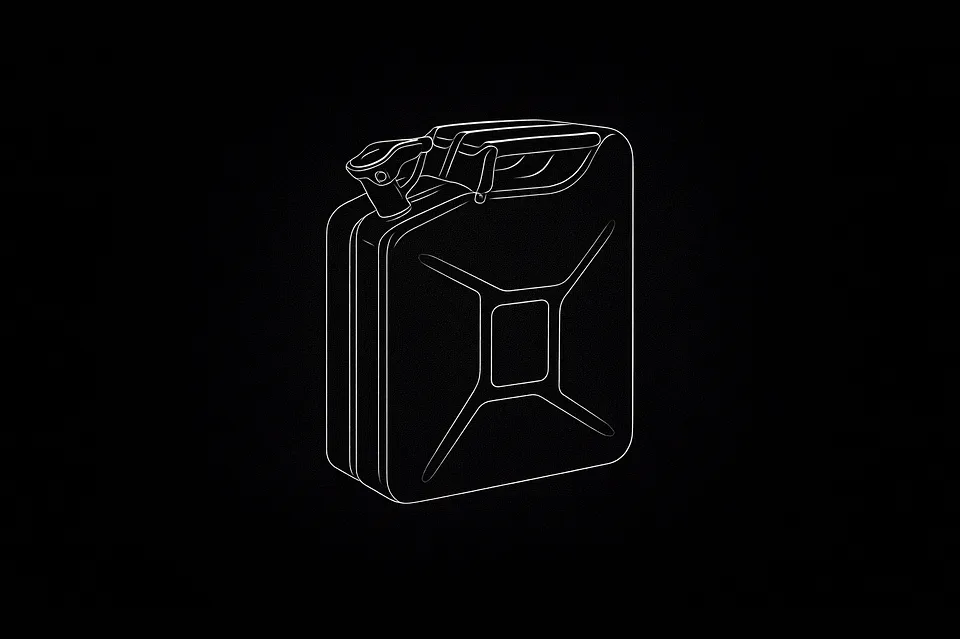
Brent Beshore calls this Dirty Fuel. An external force pushing you forward. Powerful. Relentless. And when you harness it for productivity, it will put you on a path to success.
But at a certain point, what drove you to success becomes the thing that destroys you.
For me, this hit about seven years into building Outway.
By most measures, I’d 'made it. Multi-millions in annual revenue for years running. A brand recognized across the country. Everything I wanted to prove, I had proved.
That I didn’t need permission. I didn’t need to make a team. I could just do things, and be great.
But once you stop trying to prove to the world you’re great, you’re left with emptiness.
Decades of laser focus, searching for external validation. Chasing results, completely ignoring what’s inside.
The question “why do I do what I do” started flooding in and I had no answer.
That’s what led me to Jack Skeen.
My friend Andrew Wilkinson connected us. I texted Andrew while wrestling with questions about meaning, and he said I needed to talk to Jack.
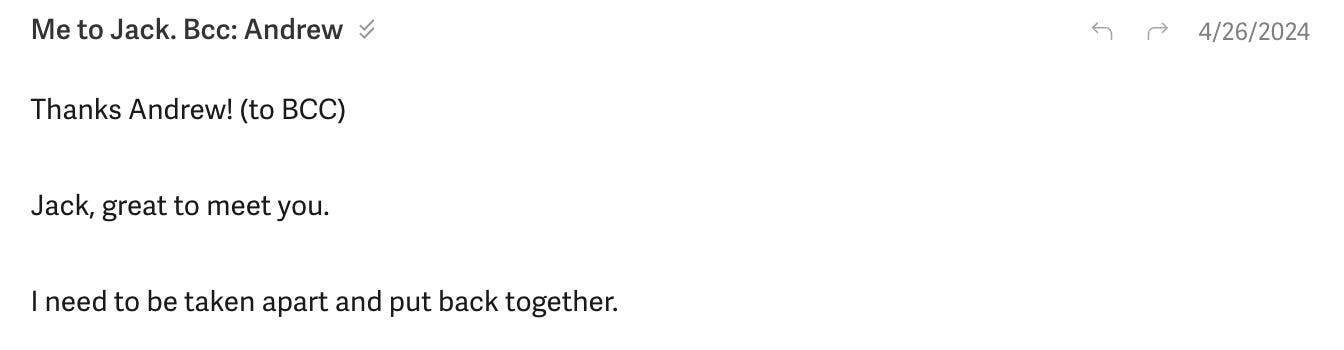
Jack works with executives and high performers to find their life’s purpose through a process he calls the Roadmap.
It’s intensive. Interviews with the people closest to you, six deep working sessions, and two clinical psychological assessments. Then Jack takes everything and builds an operating manual of you.
Mine was 50+ pages. The good, the bad, the ugly.
Reading it is jarring. You’re staring into a mirror and seeing every part of yourself, specifically the parts you’ve spent your whole life avoiding.
My biggest takeaway was learning to let go of caring what others think.
At the time, I felt insecure about my business. Although successful, I had this lingering feeling that socks weren’t enough.
And honestly, it wasn’t completely unfounded. When people ask what I do, especially in a room full of “successful” people, and I say “I run a sock company,” they look right through me. Like they want to pat me on the head. “Oh, good for you. We all have to start somewhere.”
I could clap back. Let them know we sell millions of pairs a year and that our brand is one of the best in the world. But that would be lame.
So I’d swallow that feeling and move on.
I shared this with Jack. And he said something that changed everything:
“Rob, if you were selling shoes, would that be enough? What about sports equipment? Would any of that be enough?”
I thought about shoes and about the respect I have for a brand like Nike. Then I asked myself: are shoes inherently “better” than socks? No, just different.
Jack said: “It’s not about what you sell. It’s that you become the best you can possibly be at selling that thing. You love socks. The passion you have for the product and the business, I don’t see that often. That’s what makes you great.”
And something clicked.
I was focused externally, wondering if people thought I was great. When the whole time, I just needed to focus on being great.
I had built an adult exterior to protect the kid inside. The one who wanted to belong. To be loved. To be seen.
But searching for that externally is a race with no finish line. You hit the goal, and the emptiness is still there. So you set another goal. Then another. Hoping the next one will finally be enough.
It never is. Because you’re solving for the wrong variable.
Dirty fuel got me here. It lit the fire, built the company, forged discipline. I’m grateful for it. I wouldn’t have the life I have without that chip on my shoulder.
But dirty fuel has a cost. It will burn you. Your confidence becomes a function of other people’s opinions. Your drive becomes a reaction to a wound you never actually healed. And eventually, the thing that made you relentless starts making you miserable.
The shift wasn’t some overnight transformation. It was slow and uncomfortable. Learning to sit with the question: if nobody was watching, if nobody cared, if there was no audience to prove wrong, would I still do this?
The answer was yes.
Not because of what it proves. Because of who it makes me.
That’s clean fuel. A commitment to improving every day, for me. A desire to build the best business I possibly can, for me. A passion for performance and a hunger for greatness that doesn’t depend on anyone else’s approval.
Dirty fuel will build you something impressive. Maybe even something great. But you’ll spend your whole life one bad opinion away from questioning all of it.
I don’t want to live like that anymore.
Clean fuel is quieter. It doesn’t need the room to notice. It just needs me to show up tomorrow and be better than I was today.
Nobody can take that from you. Because it was never theirs to give.